I was delighted when, one sunny day, I was introduced to Hans and Penny at the Clinic Office. I had to restrain the urge to call them Ha’penny – the English term for a half penny coin no longer in circulation but a fond memory of my youth and a year spent in Norwich, England. Hans was an avid spelunker, and he and I could chat for hours about caves we had known and loved. Since I went to school at West Virginia University, caves were a frequent delight. Many of my good friends were Grotto troglodytes.
Hans had been hired to check out the many caves of the Grand Canyon. With that much limestone, they were almost everywhere, and I had even been into several, including that more explored one along the Grandview Trail. However, he was focused on the many unexplored caves, and the hope was that they could locate some new and interesting natural and archeological resources.
The project involved surveying the miles and miles of Canyon wall, searching for anything that just MIGHT be a cave. Once a good prospect was identified, they would hitch up a rope and rappel down, looking to see how deep it might be, and if it showed any signs of habitation, human or otherwise. The caves they discovered and explored were not easily accessible, to say the very least.
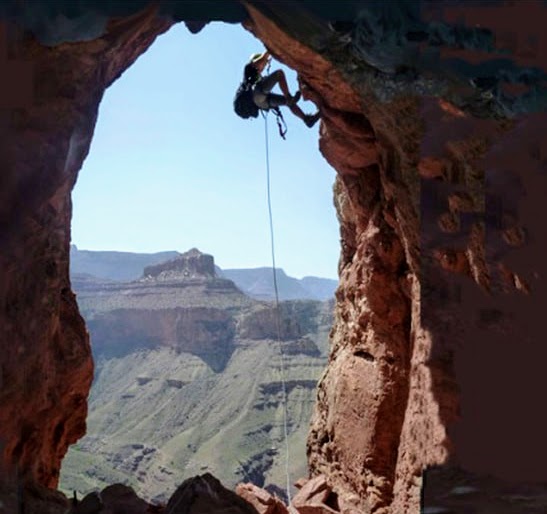
While we had a crack team of archeologists on staff, somehow John was supervising the operation of the two climber/spelunkers with cooperation and guidance from that archeology team. At the head of the team was Dr. “Bill,” legendary and elderly, an expert on all things Anasazi.
Hans and Penny would disappear for days, checking walls and scrambling up and down the steep cliffs of the Canyon. They would hike to all kinds of nigh inaccessible locales, and it was always fun to catch up on their adventures when they dragged their dusty butts back to the office.
One day they returned, clearly excited about a find, and I was looking forward to the full report. Then – conflict, confusion, and outrage erupted! Doors slamming and loud voices, almost unheard in the usually peaceful offices of the Resources Management Division. What on Earth could be going on? The tension in the office was excruciating.
We heard the story later on. In the course of doing their thing, they had found a cave untouched since prehistory, one of those heart-stopping times in anyone’s life. Deep in the cave, they had found a twisted yucca sandal, along with a few other artifacts. Here is a photo of one a lot like it, found in nearby Zion National Park.
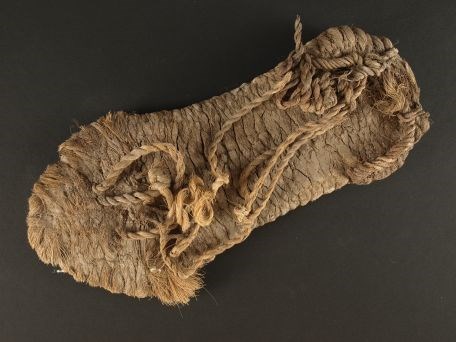
Sandals like this are not particularly rare, but to find one undisturbed was a great find.
Dr. Bill was excited, too, and started making arrangements to immediately fly to the area in the Park Service helicopter. He planned to work with his team to have himself lowered down the cliff, enter the cave, and check out the findings in person. I was pretty amused at the mental image this conjured, as his was a substantial girth, but he seemed determined to personally check out this new, yet virtually undisturbed, find.
Hans was willing to help him get there, on one condition. The sandal was to stay there, and nothing was to be removed. The remote location would protect it for another few centuries, at a minimum.
Dr. Bill was not best pleased. He would not agree to that condition, and the fur flew. Hans and Penny remained firm that the site was not to be “plundered,” even if the full (and considerable) weight of scientific discovery came down on them. I don’t think I was ever more proud of my fellow spelunkers! John backed them up.
The kerfuffle was of course elevated, with all kinds of Park Service experts, Directors, and staff dragged in. My understanding is that ultimately, the location remained a secret, and Hans and Penny were able to keep that sandal right where it was, wherever it was. They had at least photo-documented it when they first found it.
I hope it remains undisturbed to this day! Who knows what weird science will tease additional clues and information about such finds for future generations. Best to leave some of the treasures to them.

Flash Update: In preparing for this tale to “go live,” I reached out to Hans. He confirmed that the sandal was still in place, having visited it long after its discovery with his Cave Club. He is now in Montana, sharing his knowledge with students about Geographic Information Systems and helping a new generation appreciate the wonders of the incredible worlds below our feet.
Regions in the world where limestone occurs in large amounts, the remains of prehistoric seas and layer upon layer of shells, are known as karst. While other rock formations are soluble, like gypsum, rainwater, especially when slightly acidic, combines with limestone to form underground streams and cavities, as well as fantastic natural sculptures with names like soda straws, cave pearls, and bacon rind. A carbonic acid solution carves through karst. Over time, these spaces can drain, and flood again. The Grand Canyon is such a karst region. Hans estimates that there are about 300 significant caves within the Grand Canyon. There are surely many more.
He also shared a Youtube video which features his Bigfork High School Cave Club.
 Mi Mayan Hamaca