P.S. and I loaded up our backpacks with goodies and granola bars and LOTS of water. He added his decibel meter and lots of extra batteries. I loaded up a clipboard (really?) and several pencils and a sheaf of surveys (double-sided, I can assure you). We were going in – and not just a stroll down the Bright Angel.
John provided the keys to a small ranger outpost down by Hermit Creek, a little over 8 miles below the rim. The rangers were not planning to use it for the next few days, so we had the place to ourselves. Not having to haul a tent down helped to make up for all of the paper I was hauling. I later learned that tents were optional for much of the year.
Not sure why my ex did not go along, as she was an avid hiker, but it would just be me and my well-dressed Indian companion for the overnight hike. We took the shuttle bus from South Rim Village west out along the rim, past the Abyss, to Hermit’s Rest.
Whoever fights monsters should see to it that in the process he does not become a monster. And if you gaze long enough into an abyss, the abyss will gaze back into you.
Friedrich Nietzsche
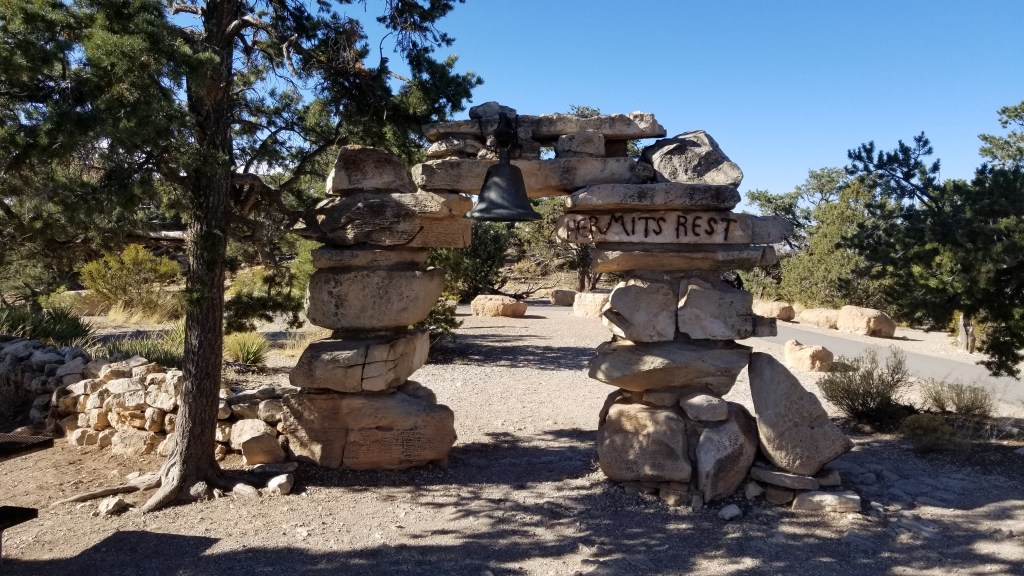
Hermit’s Rest was named for a Canadian miner, Louis Boucher. After arriving at the Canyon around 1889, he ran mule trips for tourists at Hance Ranch for a while, but eventually decided to set up his own operation to the west, based on a water source he had discovered at a location he named Dripping Springs. He built a trail into the area, and even set up an orchard with an irrigation system from the Springs. His side canyon was beautiful, and we were excited to be heading out to explore its depths.
The trail started out very gradually, as I recall. There were times when the trail went up, to my annoyance, meaning we would just have to go down again – but that did not happen very often. The day was gorgeous, and the views were sublime. Almost as deep into a side canyon as the Bright Angel, the Hermit Trail was refreshing after days on the “Main Drag.” And almost deserted. My surveys stayed blank and in my pack, pristine – well, no, they had acquired the patina of red Canyon dust that everything else there acquires. I was disappointed. I had hoped to bag a REAL backcountry hiker or two in the wild, and they seemed as elusive as the Bighorn sheep we had heard about, but never seen.
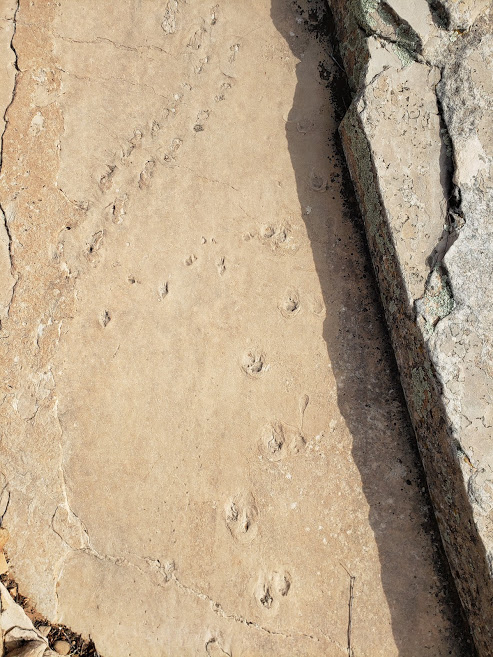
The Coconino sandstone is a beautiful almost white cake of prehistoric sand. Once the Trail dropped below that level, slabs of the stuff were everywhere, revealing the ripples and details of prehistoric desert. If one searches for a while, it is quite common to spot the fossilized tracks of critters that once skittered across the ancient sands.
About mid-morning, I fell in love. With a privy. Seriously. A two-holer. Each throne was enclosed, but only on three sides. There was no door. Take care of business and enjoy the view. It was spectacular. I have often, over the years, thought about that experience, and wondered whether it is still there. I very much doubt it, which is a crying shame. Guess I will just have to head back and see, but I really don’t want to KNOW it’s gone. It will always be there in my memory.
At one point, I startled a big rattler who was enjoying the sunshine on the trail. The rattle shook, and P.S. looked ready to head back to the Rim. I admired the snake from a safe distance and we both decided he had the right of way on THAT section of trail.
We got down to the Ranger Station, a cosy but very small cabin with a small notebook capturing comments from the Rangers who’d hiked past or spent the night, a first aid collection, two small cots, and lots of dusty windows so one could keep an eye on the surroundings. It was perched just above Hermit Creek amid some cottonwoods. We could hear the stream gurgling below the shaded banks.
We were following the trail on down toward the Creek when we heard voices. The Creek was tucked down into a deep fold of canyon, and we glanced over the side of the trail into the shady oasis. Backcountry hikers! Feminine! And – er, without a stitch, as God hath made us all.
My Indian friend looked a bit more perturbed than I was, I believe. His wife was in India, while mine was just above the Rim. We made a few noises, a cough and some gravel scattering to announce our presence. We gave them a moment; the ladies had heard us and swiftly covered up. I tried to wipe the smile off my face as I sat my pack down – and produced my clipboard. They completed some of the first surveys that were not returned by mail. I tried to ignore the blushes.
I should have had those surveys framed.
The pool was inviting indeed. After thanking the ladies for the surveys, they went laughing off downstream to the campground, and I quickly peeled – to underwear (maybe?) and dropped my dusty bod into the lovely stream. Relaxed, oh, my. Perfection. In the midst of a hot and arid canyon, the pool of chilly water deep enough to totally immerse was bliss.
Suddenly I heard P.S. yelling on the bank. I reluctantly rose. He was busy chasing a squirrel away from my pack. The wee rascal had completely shredded one of the pockets, and was happily working his (or her) way through a granola bar, almost but not quite sharing it with some of her (or his) pals just above the pool. Probably comparing it with the Trail Mix the women had been carrying. It must have been a successful franchise. The squirrels near the pool looked well-padded, with nice shiny coats. It was clearly a well-practiced routine, and another successful score for the Home Team. Did that critter just spike an M&M?

There was a trail below which led down through the campground to the river. We elected to stay at the ranger station as planned, but I visited the campground below for a while – chatting with our new friends. I kept a pretty close lookout on my pack after that. As we stretched out that evening, ate a small meal, and settled back for the night, I used my food bag for a pillow, not willing to risk any more pilferage.
Sometime that dark morning, a rock fell. A big rock. Loud, and scary, and making one once again respect (and fear) those massive cliffs all around. Reading the Ranger reports in the station, I learned that recently people camping below us reported a rock the size of a railroad boxcar that had slammed into the canyon from the hill above. Look up with respect. Each boulder, rock, pebble, and grain of sand you see as you look at the Grand Canyon is poised to plunge. A drop of rain, a frosty spell, or just plain time will inevitably see it plunge into the depths. How many other rocks it takes with it depends on many factors, but sooner of later it will descend. Erosion happens!
We hiked out of Hermit the next day, climbing past the shale which the Hermit (or somebody who followed after) had named after his lonely life. Only two survey responses, and a good deal of hiking to get them (and an eyeful, pardon me, ma’am.) But it was a start.

I am napping on that backpack, perhaps shredded at this point. You can see my quest for customizing; I’ve stitched sheepskin pads to each of the shoulder straps.
One of the nice things about working for the National Park Service are the opportunities to make employee purchases of outdoor gear. There are other names for this activity, like branding. It looks cool when your Ranger shows up carrying packs or other gear with the patches of your company. Fortunately for me, one of those companies was Lowe’s, and when I got back to the rim, I set aside my external framed, green, and sadly shredded pack and ordered an upgrade. Yes, the old pack was still relatively functional, except for that one stupid pocket that one danged squirrel had shredded in milliseconds.
Now it just made me look like a hick on the trail. Dang squirrels!
How well we have those little rascals trained. I’ve been using bear canisters for a few years now, and I truly wish I had owned a squirrel canister back then. I wonder which would be smarter, the bear or the squirrel? I can just see that competition play out. Bears are smart, but I have seen squirrels go to work on bird feeders, and I believe they would give a bear a run for its money.
Years later, I captured this 360 photo down the Hermit Trail.

P.S. and I enjoyed hanging out at trailheads, and I had learned to operate his decibel meters. We would chat about growing up in Connecticut and India; the English heritage (and colonial occupation?) a common element. Over snacks of fresh pinyon nuts which we shared with the Kaibab squirrels, we talked about school and our educational efforts, wives, and the opportunity to spend some time at this glorious place.
One of our favorite spots was Grandview. At one time this point hosted a large tourist hotel, which had gradually turned to salvage or sawdust on the rim, east of the Village. A fairly steady stream of tourists came by, but only a very few contemplated heading down the Grandview Trail. The Point was not one of the Canyon’s largest, yet we frequently had company. Native Americans, here first, would stop by and lay out impressive arrays of jewelry on blankets. Each item was carefully secured to the blanket, and the display was designed to roll and go, as this activity in the Park was illegal. Typically, one of them would serve as lookout, and any time a government vehicle arrived, the glittering displays of silver and turquoise would disappear in an instant and the commercial activity would vanish in the bush.
P.S. and I watched this game of cat and mouse with amusement; we did not see a great deal of difference between these sales and the sanctioned ones at the Village, so we never reported it. We didn’t carry radios anyway. Mostly what he was interested in were aircraft decibels, and I just wanted REAL hikers climbing out of the Canyon. Eventually, I convinced the team that we should descend the Grandview Trail to Horseshoe Mesa, which I had stared at from above for far too long.
Horseshoe Mesa was the site of a copper mine about the same time that the hotel had perched on the rim far above. I had heard from a friend that there was something special to check out down there. We loaded up our packs one day and headed down the Grandview.
It is a bit more exposed than a number of the other trails we had been down, and up. We wound around below the point, enjoying fantastic views of the Mesa above the Tonto Plateau and then, below that, the River, occasionally visible far below the Mesa. At one point, we encountered several mules and a trail crew, big men hoisting large rocks and bigger logs into place, crafting water bars to prevent the Trail from becoming a stream during the “Wet” as they say in Australia.
They nodded and greeted us. One had played hackeysack with us a time or two. We chatted, grabbed a drink in the shade (never ever stop in the sun to rest) and continued down to the Mesa.
When we got there, we could discern the remains of several buildings which were about all that remained of the mining camp. Next to the cookhouse, I was amazed. Cans, and cans, and still more cans, thousands, turning to rust in the dry sunshine. I could not begin to imagine all the mules who must have groaned as their load of cans was strapped on and they started down the Trail. How many meals of beans?! The campfires must have been fragrant. And those beasts (the mules, of course) would have left the beans below only to haul copper ore up the same steep hillside. What an existence!
One could see green tailings where the copper ore had been chipped out of the Mesa, and a few small mine entrances, blocked or filled in for safety. This was no place for little Timmy to play, and Lassie would have had a long way to go for help.
I was off for something much cooler, though. The Trail cuts across the Mesa, and moves down into breaks in the massive limestone cliffs of the Redwall left and right. But there, tucked just below the rim, as the Trail moved into the descent, there was and I am sure still is an opening in the hillside. We turned on flashlights and cautiously made our way inside a cave; well explored and popular – well, at least as popular as a place can be halfway into Grand Canyon. Caves are a lovely place to stop in the desert, providing a cool resting point. Caves in Arizona, depending on their depth, range from about 60 to 70 degrees Fahrenheit. Never stop to rest in the sun, and if you can manage it, a cave is so much better.
It was lovely, with an entrance that gyred away to the left, over stones that have been around for millennia. We looked for any evidence of Anasazi residence, but I do not remember seeing any. However I am sure Kilroy and some of the tribe had been there. This would be just their kind of place to chill.
I had been fascinated with caves at an early age, and attending West Virginia University was, well, “Almost Heaven.” I would spend weekends crawling through narrow spaces with a carbide lamp attached to my scuffed helmet, seeking out chambers with soda straws, stalagmites and stalactites (the ones that hold “tight” to the cave roof). I remember one remarkable muddy crawl with barely enough room to lift my head and sight down the passage. As I was inching through the ooze, I twisted my head at one point – to stare into the eyes of a small gnome, several inches high, brandishing a small club and grinning fiercely. Caver humor; someone had scooped up a few handfuls of clay and fashioned the little fellow to guard this narrow and stygian passage.
We did not explore very deeply that day below the Mesa, as we had no helmets (first rule of spelunking) and just a couple of flashlights (second rule is three sources of light). I made a quiet vow to return some day as we started back up the hill. Not sure how many surveys I got filled out that day, but Grandview lived up to the billing.
 Mi Mayan Hamaca