Much has been said about the idea that if I just had ten things, I could walk out the back door and survive anything. Cannibals, fer de lance (a most wicked snake), tornadoes…
I would argue that there are not ten things, but ten systems that need to be addressed.
I use my fingers to teach those I lead outdoors a memory tool that helps them (and me) remember.

RIGHT HAND
I start with the right hand, and the central three fingers of comfort. I do not want to be too HOT, too COLD, or too WET. Unless snorkeling. Each goal employs a system.
1. Too HOT? Yes, even in winter. My goal is no sweat. Vent, shed, stay comfortable. I also need to consider snow blindness and sunburn, so protection from those as well. Hat with a brim? Goggles? Glacier glasses? Whatever it takes to avoid becoming overheated and stay protected from the sun. Remember the snow reflects under the chin and strikes places you normally do not need to consider in summer.
2. Too COLD? It happens. I try to monitor my temperature and have my partner(s) check me as well. I’ll add layers as I need to, and when it gets really uncomfortable, I’m off to that ultimate layer – my sleeping bag. Critical to comfort there is a good sleeping pad. With a hat, down booties, a good book and dry gloves, staying warm in winter involves wise layering to stay “just right”. Be Goldilocks!
3. Too WET? Please no. I’ll don that outer shell and brush ALL of the snow off and try to avoid overhead tree snow bombs. I’ll try to have some form of shelter, even if I have to build it. A lightweight bivouac can do the job. You should always be in a position to stay overnight, even if you thought it would just be a day.
I encourage the everyone to constantly monitor and brush snow off their clothing, and, with permission, do the same for others. If it stays stuck, it will soon become water – or ice.
4 and 5. The thumb and pinky of that right hand are for FOOD and WATER. Guess which priority I assign to the thumb! One can go 3 weeks without food, but just 3 days without water.
For extra credit: Discuss why being too dry is not on my list.

LEFT HAND
6 and 7.
Left hand, and the two finger salute (6 and 7). FIRE and LIGHT. I want to be able to see in the dark (I find a good headlamp works best) and light a fire (waterproof matches, flint and steel, knowledge of tinder, Sterno, etc.). In a pinch, fire can produce some light, especially if I have a candle.
8. The left thumb is my FIRST AID kit, but it also includes a basic toilet kit: medications, toothbrush, floss, toilet paper, insect repellent; everything I need to stay happy and healthy in the wilds.
9. Next, a TOOL. Preferably a 48 function Swiss Army knife with a flare gun, dinner set, and genuine police whistle (thanks to troubadour and Staff Sergeant Barry Sadler, Green Beret Medic). But I’d settle for a Bowie knife. A repair kit for critical items is a great supplement.
10. Finally, the real estate question. LOCATE ME: location, location, location. This is a three-part item.
First location: Where am I? Yes, a GPS is a nifty tool, and I think I can handle a compass, but how good is my map?
Second location: Vastly more important, does somebody out there (not here with me!) know where I started, where I plan to go, who is with me, and when I plan to return? Make sure you and someone else knows where you are!
Third location: If you have a PLAN B, plan c, etc. (and you should) does that other person know where you plan to go if that backup plan is necessary?
Those are MY ten essentials, and an easy way to help remember them.

Here are the Ten Essentials from a few other sources.
Can you spot what might be missing?
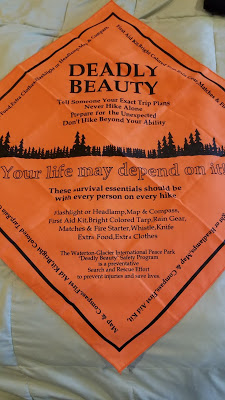

A watch? Really?
And below:
From the Boy Scout Handbook of 1999, p. 207. (Hope they remember to fill that water bottle!)

AND finally, this GEM, courtesy of Troop 405, Pleasant Hill, CA. You RULE!

TEN ESSENTIALS: “THE CLASSIC” LIST
- Map
- Compass
- Sunglasses and sunscreen
- Extra clothing
- Headlamp or flashlight
- First-aid supplies
- Firestarter
- Matches
- Knife
- Extra food
Remarkably, the classic list did not include one key item.
Water, anyone?
TEN ESSENTIALS: FREEDOM 9 SYSTEMS
- Navigation: Map, altimeter, compass, [GPS device], [PLB or satellite communicators], [extra batteries or battery pack]
- Headlamp: Plus extra batteries
- Sun Protection: Sunglasses, sun-protective clothes, and sunscreen
- First Aid: Including foot care and insect repellent (if required)
- Knife: Plus repair kit
- Fire: Matches, lighter and tinder, or stove as appropriate
- Shelter: Carried at all times (can be light emergency bivy)
- Extra Food: Beyond minimum expectation
- Extra Water: Beyond minimum expectation, or the means to purify
- Extra Clothes: Beyond minimum expectation
My additional essential – though this is a really good list:
Does anyone know where I am?
THE “REAL” HANDY BUT NON-ESSENTIALS
Once you have taken care of the essentials, there are a number of items it is generally useful to haul along – especially if car camping. Some of these have already been included in the section on Winter Driving.
- Avalanche Beacon
- Avalanche Probe
- Snow Shovel
- Duct or duck?! Tape
- Tool Kit
- Flares
- Tarps
- Rope and Cord
- Wool and/or Foil Blankets
- Wire
- Billy Can
- Candles
- Fish Hooks and some line
- Tin Foil
- Needle & Thread
- Moleskin
- Hand Sanitizer/Fire Starter
- Extra Glasses for those requiring them
- Spare Key to the vehicle
- Safety Pins
- Carabiners
- Jumper Cables
- Tire Chains
- Window Ice Scraper
- Bear Canister
Have you filled up your SUV yet?
Any others you can think of?
 Mi Mayan Hamaca