Bed is the poor man’s opera.
Italian proverb
I try to keep most things out of the hammock other than myself and perhaps a few close friends. One thing I discourage strongly is shoes, and it is a precondition to remove them before hopping in.
However, I often build a bed underneath me, particularly in cooler weather. While the weave of the hammock can provide lovely air circulation on a hot day (one of its nicest features) it can also allow breezes down one’s back in cooler weather. I almost always set up some sort of padding underneath me, with the possible exception of the mobile hammock and warm weather.
At its simplest, this can be a pillow or two. I almost always have a small pillow for my head to get the right angle for comfort. I really do NOT like a stiff neck! The other pillow I commonly use is for lumbar support, usually a roll or bolster-style pillow in the small of the back. A physical therapist at one point insisted I do this, and he is correct. He also wrote up a glowing report at the conclusion to my therapy, encouraging other therapists to check out the series of hammock exercises I demonstrated for him one day.

I will often put a pillow behind my knees, to make sure that legs remain slightly bent. Locking one’s legs in the hammock is not a good idea (especially at nap time) and if done for any period of time will make exiting an uncomfortable experience. Bend your legs or poke them over the side.
I will occasionally use a fourth pillow as a “kicker,” something to push with the feet. This is particularly useful, like a small footstool, when the cool breezes blow. So – four pillows; head pillow, lower back, behind the knees, and a “kicker.”
With my two “permanent” hammock installations, I also use blankets or sleeping pads. I have found that a down quilt is lovely and warm when things start getting breezy. I lay on it diagonally, so that one corner is at my feet, one on either side for wrapping, and another behind my head. This provides greater length and comfort. For the foot corner, I tie a small knot, which allows one to poke a toe behind the knot and push the corner all the way out under one’s feet.
I have also added sleeping pads, like those one would take camping, to the “stack.” I’ve found the shorter ones are a better fit, going from behind the head to below the buttocks. Inflatable air mattresses, with just a bit of air (not fully inflated) work well.

An interesting factoid about Mayan hammocks is that the most vertical (flat) position does not happen when one is laying sideways, or along the axis of the hammock (end to end) but at an angle. Someone who is a lot better at geometry than I would have to explain why, but if you prefer to relax or sleep as flat as possible, angle your position somewhat.
When lying sideways in the hammock, the angle of the two sides should rise at about a 45 degree angle on either side. If the two points of attachment are too far apart, you will be in a taut hammock that is uncomfortable to me, and has much less give. If the points are too close together, you will be down at the bottom of a “U” that is not too uncomfortable, but a bit claustrophobic. Sometimes you can correct the taut hammock by raising the connecting points and using a longer cord to compensate, but you just might have to climb a tree.
For the ultimate in comfort, I’ve also added a electric back massage pad, which can not only provide a soothing massage but also heat, as needed. This requires electrical cords and a connection, but I have enjoyed mine and installed one both indoors and outdoors. The good Dr. Scholl makes a model which does not turn off after a set period of time, so I can take a nap and not have the pad shut off. Most of the other models require one to keep pushing a button, more annoying than feeding the meter.
One note of caution: these pads come with all kinds of warnings about use. Actually, so do some of the recent hammocks I have ordered. The litigious are everywhere. So, follow all precautions and consult with your physician before proceeding with any hammock lounging. There, I have said it!
I should also note that if one gets out of the hammock, one can watch the massage pad hum and slowly collect any crumbs that were deposited in the hammock into clusters for easy removal.
A second note, as I am at it. Check periodically under your hammock pad for any stray objects which may have popped lose and may be working their way through the cords. Being comfortable on top may hide lurking dangers, such as a bottle cap or pistachio nut shell, which over time may cause damage.
While I try, with both my indoor and outdoor home hammocks, to leave this sleeping pad in place, for the outdoor model I will wrap it all up in place inside the hammock, clip the ends together and twist them up, and either bring it all in or cover it with a waterproof wrapping. It does take a bit of arranging to recreate my “nest” the following afternoon, but I just don’t leave it outdoors.
Having everything connected overhead means that I do not need much in the way of objects floating around in the hammock, migrating where I don’t want them, but some things make the bed much more comfortable. One additional item for cooler weather is a thick pair of socks, slipper socks, or down booties that will keep the feet warm. I have made a bundle from a light sweater or jacket, socks, and gloves which resembles a small pillow but can be opened to disperse warmth as needed.
My dear wife actually created the “ultimate” hammock pad or snugglie for cold weather use. It is made of fleece, lined along the back and feet. The feet sit inside a pocket, which is also lined underneath with Thinsulate, as is the back. The sides wrap all the way over the top to create a double covering. Sleeves on either side allow one to use one’s hands easily while staying warm, and even have two hand pockets in the sleeve, like a Chinese robe, to keep hands warm. Finally, it has a lined hood. It can actually be worn as a robe when the foot pocket is folded up in back, and is very monkish, or would be if it was not a mottled blue with peace signs featured on the liner.
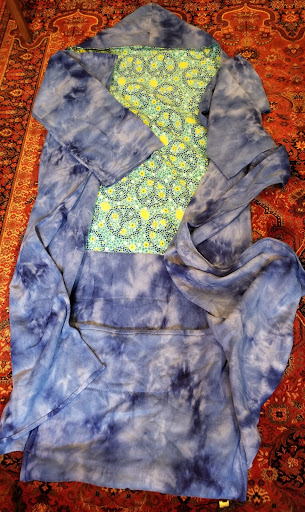
So, depending on the weather, that is some of what provides comfort in my hammock bed. Other times, it is nice to sling in a bed that lets every breeze through. With climate change, I may need to spend more time searching out whatever breezes I can savor.
An article in the newspaper talked about the virtues of hammocking. It said “Lying on the ground disturbs the lawn and other outdoor components. Being suspended several inches above the ground in a chair or hammock can help a person blend in with the natural environment. Birds, small animals, and insects may not even know you are there, and that can make them easier to observe.” (Bay Area News Group, Metro Creative Real Estate Section, Sunday, May 26, 2019, p. J20)
I am not a gopher, so my lawn disruption is minimal, even if I had a lawn – which my wife banished a while ago in favor of a xeriscape. I do agree that many animals and birds see the hammock (and occupant) as part of the landscape, and I enjoy watching them perform. Placing bird feeders in the area enhances the whole experience.
Many hammocks are so flexible that they can be pulled up and around, creating a cocoon of color. If the sun begins to get to be too much (I almost always place my back toward it if possible) one can actually get a little shade by pulling the sides over the top.

Another technique I call the foldover is made by folding the lower edge over a foot or two, creating a hammock “footstool.” Here is what that looks like. The same thing might work as a pillow on the other side of the hammock.

 Mi Mayan Hamaca