By Sterling Bobbitt
The baby was crying. John struggled to achieve consciousness, went to the bathroom and relieved himself, carefully navigated the dark hallway, and walked into the child’s bedroom. The diaper was dry; maybe a bottle would settle this. He picked up the child and headed into the kitchen. Shortly, preparations were complete; a bottle for the boy and a steaming mug of coffee to cement his awakening. Both liquids were welcome, and a few moments later, the son was asleep and his father wide awake. John settled into the reclining chair, flipped on the computer embedded below the seat, and decided to go out.
He slipped on the data gloves; monitors in the arm of the chair instantly detected their presence and began recording every subtle gesture. Tiny bladders along the inside of the glove provided the illusion of touch. He slid his data lenses on, and adjusted the brightness of the stereo image. Another monitor built into the chair’s cushion began tracking his head movements. A coating on the outside of the lens went opaque; he could adjust it with a gesture of his finger. Tiny earphones, built into the frame of the glasses, slid gently into place. Microphones on the bridge could pick up a whisper.
His menu glistened in front of him, half a dozen options. An image of his hands appeared to float in space before him, glowing slightly to indicate they were sensed by the monitors. The backdrop was a forest, his favorite screen environment. The forest floor appeared to be littered with the needles and cones from the stand of redwoods surrounding him. If only he could smell them. Vivaldi’s Four Seasons was playing gently in his ear, threatening to mitigate the invigorating effects of the coffee.
He raised his hand and gestured at the menu, touching an option labeled simply; Out. A variety of persona appeared in front of him, small miniatures of his favorite avatars, or hum-icons. He pointed at a small image of himself at twenty, digitized from one of his mother’s old Polaroids. He’d edited the image some to trim some of the hair and lose the sideburns, but it didn’t look too bad (for a kid, he thought).
The menu below him shifted. Conferences, Travel, Shopping, Work, and Administrivia (he’d customized it some). He pressed Travel.
A small globe appeared at his right, slowly spinning. A touch would bring up a larger contour map of the area. Selecting a location connected him to the regional net. He could perform research, call on locals by voice or image, or even take a digitized tour of the area. Many provided a number of vacation adventures, available for a price.
His hand brushed across the southwestern United States, and a small sandy desert was painted in front of him, towns labeled neatly in red and the few rivers that weren’t usually dry pulsating in blue like large veins. He selected Adventure off a small menu, and smiled at the row of tiny images that appeared before him. He touched his favorite; the tiny raft disappeared and the scene shifted.
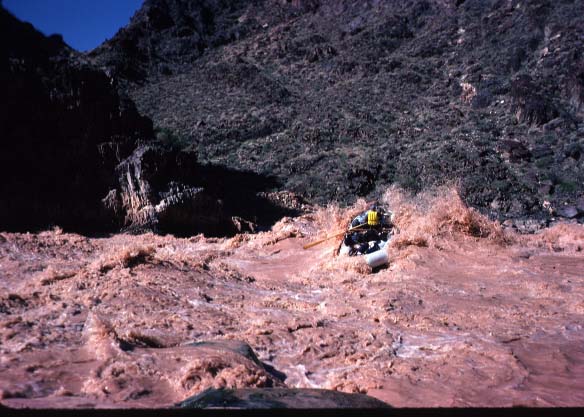
The image of sun drenched black cliffs of Vishnu Schist reflected vaguely in the flowing dark water around him. It had felt strange at first, doing this without a life jacket, after some real river running. The orange boat slid across the relatively tranquil water, but the sound of angry rapids was getting louder by the second. He glanced at his “boat mates.”
You never knew who would select this adventure. A young couple looked over at him and waved; he nodded and said “Hi.” Their selected avatars squatted on the fat tubes of the raft, wearing the fixed expressions of the simulation. Few preferred to have facial animation added to their hum-icon, preferring the mask of the image they had selected. A kid in front, whose image was wearing an outrageous foxtail hat (with three tails, no less) appeared to stare intently at the water.
He was startled by the voice of the boatman booming from behind him. “Welcome aboard. This adventure was digitized at Crystal Rapids. If you stick around, we’ll hit Lava Rapids in a few minutes, and a whole lot more river after that.” John turned to stare at the figure projected behind him. The grey-streaked whiskers and creased brown features of the boatman told of long experience on the river. Although part of the original digitization, he did not appear much more animated than the avatars surrounding him.
“So as to not clutter up the place with buttons, your menu has been imprinted on the side of the boat in front of you. Anytime you want out, just hit the Escape button. Most of the boat around you has been tactilized so you can “hang on.” Of course, it isn’t necessary. Even us boatmen aren’t crazy enough to digitize a swim in these rapids! Here we go.”
The boat moved into the heart of the roar. Water slid glassily out in the tongue of the rapids; John gripped the raft, cringing slightly at the spectacle around him. Water rose up in a wall in front of the raft; a standing wave several feet tall. John stifled a scream (knowing it would wake the baby) as the raft appeared to pitch beneath him. The front of the boat descended into the wall of water, and disappeared under the frothing mass. Though his chair remained stationary, he shifted to brace for the impact. The wave rushed around him and his heart pounded. He shut his eyes for the second that the system could fool him into thinking the water slamming into his face and chest was real. The raft finally popped over the wave and bobbed through the rapid’s aftermath. A grin was plastered on John’s face as he looked across the raft.
The young couple nodded gently, laughing and yelling. The roar of the rapids slowly subsided. Suddenly, another sound reached his ears; penetrating the illusion, the baby was beginning to fuss again. He looked down and pressed the Pause button. The image froze, and the hum-icon’s around him dissolved. The boatman was caught in the gesture of scratching his whiskers.
John slipped off the data lens, peeled off the gloves, and walked down the hall to make sure the child didn’t wake his mother.
 Mi Mayan Hamaca