The only thing I can’t stand is discomfort.
Gloria Steinem
I first fell in love with Mayan hammocks when I was about 15. It was in Romantic Willimantic, CT. That CT is a good shortcut for those who grew up in Connecticut, or those who never bothered to learn how to spell it – which is most of the universe. So it goes; lovely consonant-loaded native American names.
Anyway, the Hoot was a small store, trying to get a foothold in town. It was the store for the hippest of the hip in the area, and I was aspiring to be – HELL, NO, I was hip! And strolling down Main Street…
Owning the sidewalk, belled denims snug around my then much thinner hips. Not sure if I had my Peter Max shirt on, but if it wasn’t on my back it was in the closet. I was probably humming a tune from that brand new band, The Beatles. I was hip AND cool!
Not much was happening that glorious morning. I gazed into the window of the Hoot, and saw it descending there; a radiant arc of colors glowing in the morning sunshine. I pushed through the shop door into the aroma of incense, and the sound of temple bells, eager for a closer look.
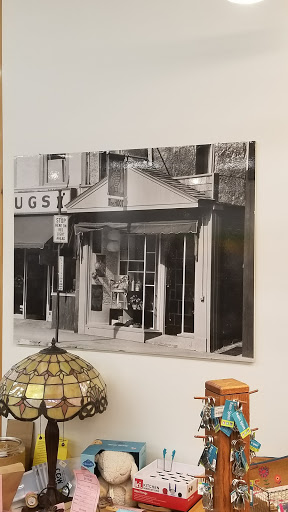
Above is a photo of the “original Hoot” where a REAL magic carpet was first discovered!
Amazingly, the Hoot is still alive and well today, although slightly more gentrified and a lot larger. They moved out to, and then near, the mall (horrors!), and did not have a Mayan hammock when I last checked, but I still recall my first look at THE HAMMOCK! Or as it should properly be described, La Hamaca.
An inverted rainbow. A beautiful swoosh of color that came down and around between two hooks and looked like one could burst right through those tiny skinny threads of cotton. Could it possibly hold me?
The lovely lady in the store said “Feel free to climb in, but first – shuck those shoes.” Then she told me that while there are many ways to relax in a Mayan hammock, one of the best was to lay in it SIDEWAYS! Oooooh! It was heavenly. This was too, too comfortable. It was relaxation unparalleled in my memory.
I swiftly discovered it could support you with ease.
The threads of a hammock illustrate the motto of the United States – E Pluribus Unum. Out of many, one. Individually, the threads could barely support a small child, but when woven into a comprehensive whole, they can be incredibly strong. Most Mayan hammocks can support multiple hundreds of pounds!
When settled in sideways, I found that you could sway back and forth (side to side) with ease. My hips and lower back flexed against the gigantic weave. A huge colorful cotton sideways rocker. Unlike the “traditional hammock,” there was no need to ask anybody to swing you. You could rock it yourself. The cotton weave on each side created two panels that would flex and push you back to the opposite side. It was soooo different from all of my previous hammock experiences, as comfortable as they were. I was entranced. A cotton cradle.

As a small child I loved to rock. I made my parents a bit crazy by curling up into a kneeling position and rocking back and forth (sideways) searching for sleep. They told wild tales of my rocking the crib across the room, inch by inch, creaking and creeping as the CPU (child propulsion unit) shifted back and forth. Apparently, I could keep it up for hours. I used to fall asleep slumped over in that crazy kneeling position.
Even as a small child, I had to move, to keep things in motion. It relaxed me, and It still does. Finally, in the sun-drenched, incense-scented, temple bellerin’ sanctum of the Hoot, I had found my zone, the perfect space, the ultimate rocker.
Many people experience seasickness, or as the French refer to it, Mal de Mer. Not many folks know that there is actually a reverse motion sickness – a need to rock.
It is sometimes known as Mal de debarquement. This condition occurs on occasion when people exit a ship after a cruise. Their body wants to keep on swaying. They have reported feeling queasy for significant amounts of time. Could a hammock help people ease themselves off the boat?
It took me a while to convince myself that the Hoot wasn’t looking for a new fixture in the hammock. And then – I had to foul up the whole dream! I made the mistake of asking how much it cost. As I recall, she asked for $100.
While very cool, I was still a teenager – barely. That was a fortune, and would require acres and acres of lawn mowing. Which I hated with a passion! Purchasing some incense to annoy my parents (sorry about that purple passion patchouli, folks), I staggered out of the shop in a daze – and returned home still a little dazed.
My parents wondered what had struck me. They were also wondering about my sudden interest in raising funds. I wanted one!

A sign, celebrating 50 years of Hooting, circa 2017. “…and still a little Hippie!”

I studied architecture at Syracuse University for a while. It seemed like a good idea at the time. One semester an instructor gave me the following challenge: design a cardboard chair.
With hammocks on the brain, I decided that MY chair needed to be suspended.
Here is a rough sketch, recreated after about 35 years. My original drawings were fantastic, which I can say only because I no longer have them.
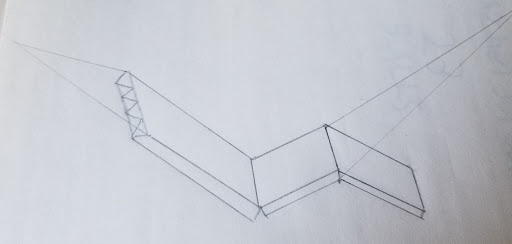
After constructing my masterwork, it was suspended in the middle of some university building’s grand entryway. Then, I gingerly climbed in. This is good advice for any hammock.
It was fantastic, just like the drawings, and then – ker-snap! – the cord supporting the head of the hammock let go! I flopped down, flat on my back, and stunningly, the hammock took the fall. Those triangular sections of cardboard managed to withstand the cord’s failure.
My instructor informed me that it was the high point of my participation in his class. I do not intend to discuss the lower elevations.
There is a great story from Booth Tarkington called “Gentle Julia.” He describes a husband, relaxing in the shade of his maples, in a traditional hammock. His wife sits nearby in a rocker; I will let Booth describe it:
Mr. and Mrs. Burgess had been happily married for fifty-three years and four months. Mr. Burgess lay in a hammock between two maple trees, and was soothingly swung by means of a string connecting the hammock and the rocking-chair in which sat Mrs. Burgess, acting as a mild motor for both the chair and the hammock.
Gentle Julia, by Booth Tarkington
Their cord connection reinforced the scene of serenity. She rocked, and he rolled. While I bless my wife for tolerating my hammeccentricities, she is not terribly interested in becoming my “mild” motor, and we don’t own a rocker in any event. Swinging in the traditional hammock requires such ingenuity.
Simply put, the traditional hammock requires a lateral force to rock. You can supply that by sticking your foot over the side and pushing the Earth. Or having someone else push, preferably someone who does not intend to send you suborbital. With a Mayan hammock, and by laying sideways, the hammock occupant can rock from side to side, becoming one’s own “mild motor.” You can still swing, of course, but rocking from side to side comes naturally. At least to this former CPU.
Many of the traditional hammocks can be just plain uncomfortable, with a large corded weave that leaves the unwary tourist who falls asleep in one looking like a human waffle. Just add some delicious New England maple syrup…
Or perhaps aloe vera.
With thanks to Saturday Night Live, here is a perfect example. Poised to flip, got a book (points for that) – but where on earth could one put a beer? If you had a nearby table, you’d probably knock it over getting in or out. Treacherous territory.

Thick weaves, spreader bars, or knots just do not make for a relaxing experience. They are the “hairshirts” of the hammock world. Am I a hammock snob? Unquestionably and unapologetically.
Warning: What follows may be habit-forming! You have been cautioned.

This is a largish Mayan Hammock. While many weaves feature mixed colors, this one has strips of solid color not commonly found. The beach is a nice touch. However, lack of shade would turn me bright red (about the color of the edges) in a hurry.
 Mi Mayan Hamaca