I don’t mind sleeping on an empty stomach, provided it isn’t my own.
Philip J. Simborg
I sleep on a bed – usually. I like to sleep next to my lovely wife, and wrestle with covers.
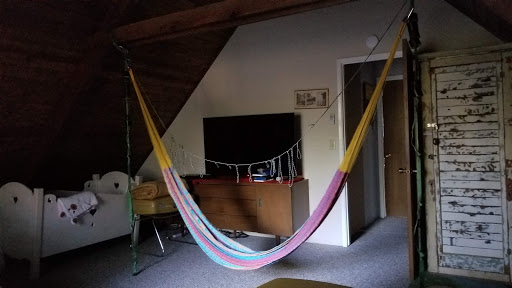
She maintains that I spend a lot of time sleeping in the hammock, but I don’t think that’s the case. I am usually reading or watching. But for a power nap, oh baby.
With streaming classical music, I am transported. Gone. As previously mentioned, turning at a bit of an angle makes a flatter hammock bed, but all of the tossing and turning I do on a flat bed is gone. I can’t usually sleep on my back in a flat bed, but it comes naturally in a hammock. The sleep tends to be deep and the awakening creates a strange sense that I was in another dimension.
A friend used to describe it this way- “I slept like a bag of hammers!”
I heard a classical musician once denounce those who would fall asleep during her performances. The somnolent impact of classical music, while complex and rich and a testimony to the musician’s skill and training, is not to be denied. If it weren’t for the soothing effects of classical music, we would never have had Haydn’s Surprise Symphony!
If you do take a nap in the hammock, here are a few cautions.
Please be sun-safe. It is easy to doze and find that the sun has inconveniently moved over to a spot where you are being blasted. Sunscreen, or deep shade!
Never lock your legs, as when you awaken they will be rubbery and unpleasant to own. A pillow behind the knees will help with this, keeping them just slightly bent and operational.
 |  |
I have had several occasions to spend the entire night in a hammock. Several were while winter camping, and while generally it is a piece of cake to climb into a hammock, when winter camping, with pads and mittens and a down sleeping bag and all of the other requisite paraphernalia, it can be quite a struggle.
My friend Keith maintains that before going to sleep while winter camping, one should take a brisk walk to appreciate the stars (I fully support that, as they can be spectacular) but also to increase blood flow and warm up before hitting the sack. He means by this hitting the sack while sleeping on a block of semi-fluffy ice. He knows how to do it!
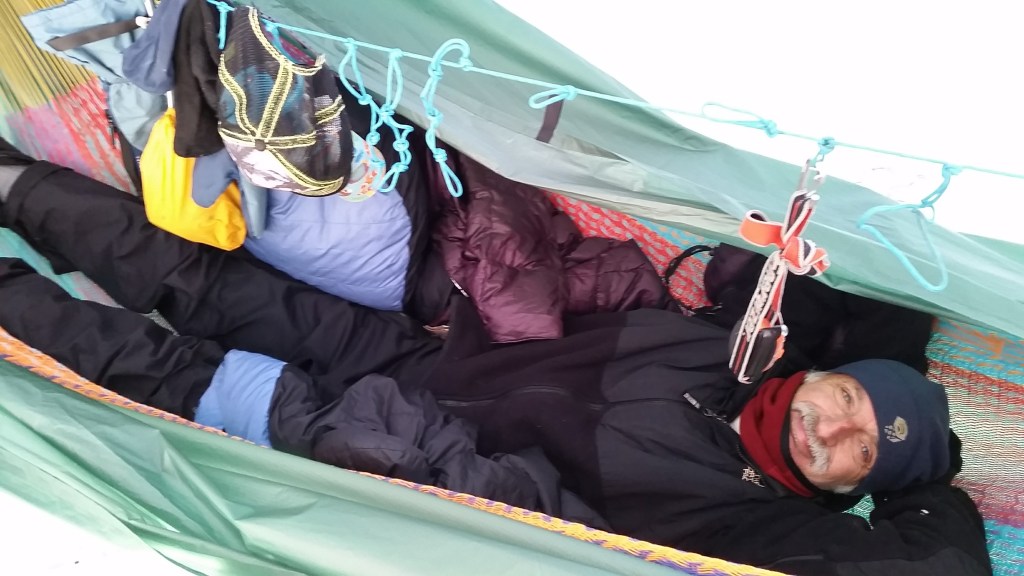
I find that just the act of getting settled, loading up the line overhead with the necessities, and reclining in the hammock provides all the heat I require. I do tend to sleep quite well – once all of this is accomplished.
I mentioned in our winter camping class that I was essentially trading conductive cooling (sleeping on snow) for convective cooling – letting the air flow around me. A bright student asked if that was a good trade off, and my answer was a definite “YES!” Except perhaps in a high wind.
It is important to recognize that the biggest factor in cooling is the compressed layer of bedding underneath one. The top part will usually take care of itself. Heat rises, and gets trapped overhead on the uncompressed side of your sleeping bag.
Underneath, it is a different story, as the weight of your body compresses the air pockets that provide the best insulation. You will want several layers underneath, I suspect, or one large thick one. One item that has been featured in almost all my winter camping is Reflectix, a sheet of bubble wrap with smaller bubbles than most and a reflective surface on both sides. Available at almost all hardware stores, it is shiny and slippery but will provide great R value (insulation) underneath. I use it to augment my usual sleeping pads.
And I hate the fact that this could be pushing more plastic. Use a wool blanket instead!
I have had to dig a small snow “nest” around the area below the hammock center, but that just gives you material for a windbreak.
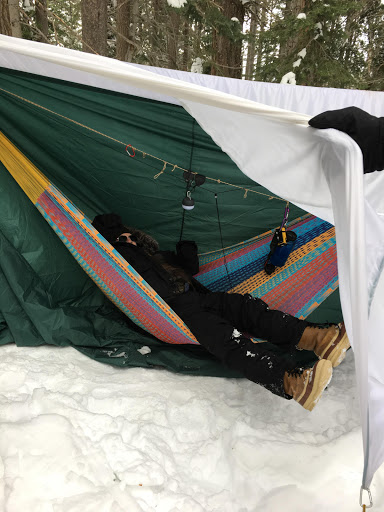
I have also had occasion to sleep in the summer, and it is much less strenuous. One does not need a down or thick sleeping bag, but a pad underneath is usually still a good idea, unless it is quite warm.
Again, my experience has been much less tossing and turning. On a flat bed, I am a side sleeper, but in a hammock I gaze at the heavens and all is right with the world. I typically sleep so deeply that I am ready to wake up when the birds decide to, rather than my usual, just a wee tad later, time.
In New England, sleeping outside can be a mosquito fest. I ordered a special hammock mosquito net, and discovered when it arrived that while it may have worked for the scrawny nylon hammocks (ahem), there was no way it could comfortably accommodate the Mayan, at least with the sideways occupant.
I went out to a local sporting good store and purchased ANOTHER net, this one designed to go over a tent. I stitched it onto the bottom of the other hammock net (after I had slit its belly) and made one voluminous mosquito mansion, with a zipper up top AND another down below.
Credit where credit is due – I am almost certain my quilting wife was prevailed upon to perform this operation. She is a very talented woman.
I found that exiting the netting through the bottom was much easier, and got me right down to earth as opposed to coming out the side and trying to reach down.

The caption above is linked to the actual photo, or one a lot like it. Again, click on the rotating arrow at upper right to see it in 360. My, do I look strange. Wonder why?
On our last trip to Hawai’i, I saw the t-shirt below and decided I needed it (not really). My wife started referring to my hammock as a man-cave. I prefer to think of hammocks as “human-caves.” They are not sexist! Or ageist for that matter.

 Mi Mayan Hamaca