We kept wandering back to the Backcountry Permit Office for more boxes. An afternoon of addressing envelopes was a pain, and we tried to break up that activity as much as possible. John finally insisted we follow up on his suggestion to traipse down and up the Bright Angel Trail a few more times to get our Canyon legs.
We got to be familiar with the mule trains who passed by, standing to the inside of the trail and holding still so as not to “spook” the beasts. We stepped oh so carefully around the fragrant pools they created – the mule “pit stops” they had designated over time. The mule stools or paddies were generally not too bad; they didn’t smell unless really fresh, and seemed to swiftly disintegrate into wisps of straw amid the dust of the trail.
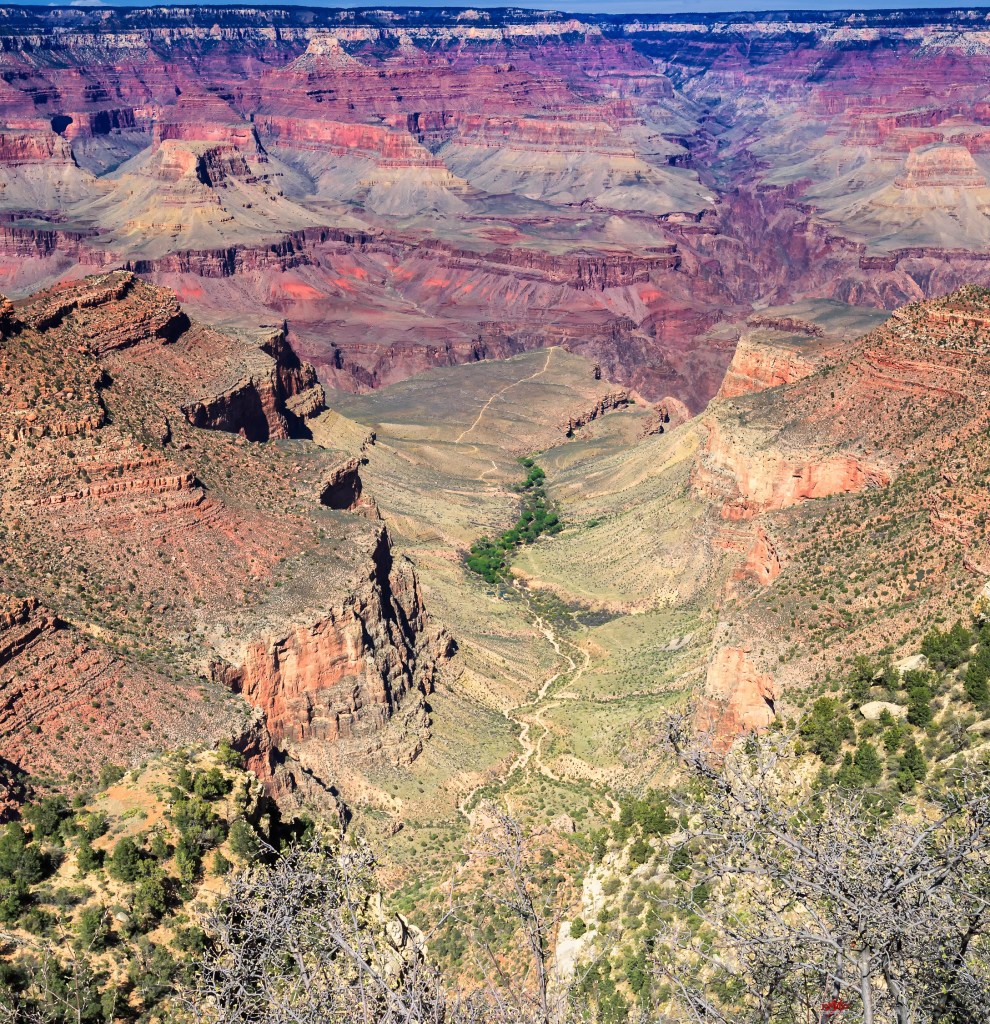
The Bright Angel Trail is the result of a large fault that splits the Canyon, right down through Phantom Ranch and up the North Kaibab Trail. The story I heard about the origin of the Bright Angel name was that Major Powell was so struck by the lovely stream he encountered when making his Canyon expedition, he contrasted it with the “Dirty Devil,” a stream loaded with silt that his expedition had been forced to collect drinking water from upriver.
A film company had stirred up a great deal of excitement recently, having shot a movie that included scenes of a one-armed actor and his team laboring to get several dories down the Canyon. It also had a number of scenes shot from a helicopter. All of this was planned to be a feature at a new IMAX theater being built in Tusayan, our nearby satellite community. Most in the Park saw it as just one more way to suck up a few more tourist dollars and promote air tours. However, I did notice that they were more than willing to take advantage of the free tickets handed out to employees when the theater was finally completed and the show available. My first IMAX, I learned that seats in the front were only for those with heads on a swivel.

The stream of hikers down the Bright Angel Trail provided a continual people-watching parade. Some were clearly experienced hikers (or looked like it) with trim packs slung on their backs and sturdy scuffed boots placed carefully along the trail. Some looked like they had wandered into a flea market and assembled camping gear with a shovel.
The aircraft noise competed with clanking pots – or mothers yelling at wayward children racing ahead. “Don’t RUN!” was a familiar plea. And it might have been in any of hundreds of languages. People from everywhere, “flocking” I believe is the term, to the Canyon. Most stayed at the rim and were content to stare down at the depths. But a great many found the trail right below the hotels and restaurants irresistible. There were those pictures of Teddy Roosevelt on what must have been a very stocky mule! Who could resist a trail like that?

Some should have. Some thought the Colorado River, a mile below, looked like a pretty easy destination. Have a drink and head back up, ignoring the fact that there were nine miles of steep winding trail in between. Blistered feet emerged from boots too new to be broke. Knees got shaky. I found the way back up pretty comfortable, but the pounding the knees took heading down! I sometimes wonder how much of my current knee tweaks and creaks come from my Canyon days.
We learned to carry extra water; it always felt good to come to the aid of a struggling soul. I carried some moleskin, too, which could have been sold at a premium by the opportunistic. I was unable to restrain myself at times, fussing at young folks who could not seem to restrain themselves from cutting the switchbacks and blazing new trails down the hillside. My wife and I didn’t have uniforms, but we knew the rules, and how to treat this place respectfully. We collected trash and relished our role as an “alternate trail patrol.”
We became familiar with the twists and turns, and the spectacular views, even though Bright Angel was buried back into one of the largest side canyons. At one and a half miles below the rim was the “Mile and a Half” house, a spot where water was tapped into from the massive water pipe that ran up the side canyon from the Colorado River. The pumps must have been huge, for almost all of the water for the Rim community came up that pipe.
At three miles down the trail was – you guessed it, “Three Mile House.” More water, and a good spot to stop and consider how much more of this trail made up a day hike. And below that, on the Tonto Plateau, was Indian Gardens.
Indian Gardens was the halfway pump house, but also a campground and a good spot to walk on level ground for a bit, as it was situated on the Tonto Plateau. There was some vegetation, but its main attraction was that with a short stroll one could peer over the edge to the dark rocks lining the Inner Gorge and that seductive river, the Colorado. John had worked to plant a variety of native species by the small stream and around the campground there, which would grow to provide shade.
The massively compressed and hardened rocks of the Inner Gorge are very different from the crumbly sand and limestone layers above. The Colorado River really had to WORK to slice that layer of the Canyon. Metamorphic rock, changed by massive heat and weight, tilted and twisted in unique folds and massive upthrusts, was generally dark and massive. It was reminiscent of Tolkien’s Land of Mordor (where the shadows lie.) And yes, the sunrise and sunset of the Inner Canyon could be just a few hours apart.
Steep cliffs, narrow trail. Think again. Did you really want to get down to the Colorado? But there, look. That swinging cable bridge! Irresistible to some who should have probably tried harder. Phantom Ranch, just beyond the cable bridge, required reservations. The number of folks who stagger in of an evening and say “I just can’t make it back up tonight” provided a routine source of revenue with the fine that they had to pay. The Bright Angel Trail is quite a route, but doing it twice in one day is not recommended, unless you are ready for 18 miles of hill.
On a recent trip to the Canyon, I noticed some new signs that were not present when I was working there. “Hiking into the Canyon is optional. Hiking out is NOT!” Truer words were never spoken. The only other way out is an expensive evacuation.

We got our Canyon legs, but the group of hikers we were focused on were not on the Bright Angel or the Kaibab Trails. We were after the elusive backcountryfolk, those that planned and sought a more remote experience. The “Corridor,” as it was known – the Bright Angel/Kaibab zone, was not included in our study, or my writer’s cramp on those envelopes would have truly been brutal. And oh, those wicked paper-cuts!
The National Park Service, at the time anyway, encouraged most hikers to stay in the Corridor. They had better sources of water. They had help available if they ran into trouble. And they had plenty of company! Campgrounds. Campfires! What was not to like?

My uncle’s wife had given me his TRS-80 (Tandy Radio Shack) computer when he passed away, and I set it up on our hallway table. As surveys started to come back in, we would check the mail daily and open envelopes like eager kids. I wrote a program that would tabulate responses, feeding them into a data table that would spit out the tallies at the end of the run.
The writer’s cramp was brutal, as the pink slips kept coming, but my wife and I took it in stages, and addressed and got more surveys mailed out. But this was not just to be a mail survey! We were also hoping to survey some of these folks in the field.
My wife, who was by then designated a VIP, or Volunteer in the Park, and I were joined by a third member of our team, a slim, polite Indian – not from the reservation, but from the country of India. P.S., as he was known to all, was our sound man. He brought two hand-held decibel meters with him from his university, and the idea was to measure ambient sound levels as well as the peak sounds when aircraft went overhead. While not “linked” with my results, we would be able to document what the actual noise level was.
P.S. recently recalled…
“I thought back to how Greyhound had misplaced my pathetic little baggage when I traveled from Laramie (UW) to Arizona. John was so terribly kind to take me to a K-Mart (I believe) the moment he found out that I didn’t even have a toothbrush on me. He paid for the items I bought there in advance of my paycheck. He then drove me straight to the South Rim to see the Canyon for the very first time. Awe inspiring!! Little did I know that there was so much, much more to see and do since that evening.”
While John was still urging us to complete several more training hikes along the Bright Angel, I was far more interested in going remote. P.S., my wife and I set off for the Canyon one day, starting near the top of the Hermit Trail. It was to be a day hike along one of the more western trails linked to South Rim Village, and got relatively little traffic. While P.S. carried his sound meters, my wife and I were loaded down with clipboards, pencils, and stacks of surveys – and water, of course. I was in a t-shirt, shorts, and floppy hat, my wife was dressed in similar fashion. P.S. – well, he knew the sun. Long sleeves and long pants – always. I tried to convince him of the virtues of what I thought cooler attire, but he knew better. Growing up in India, he knew how to deal with the heat of the Canyon’s climate.
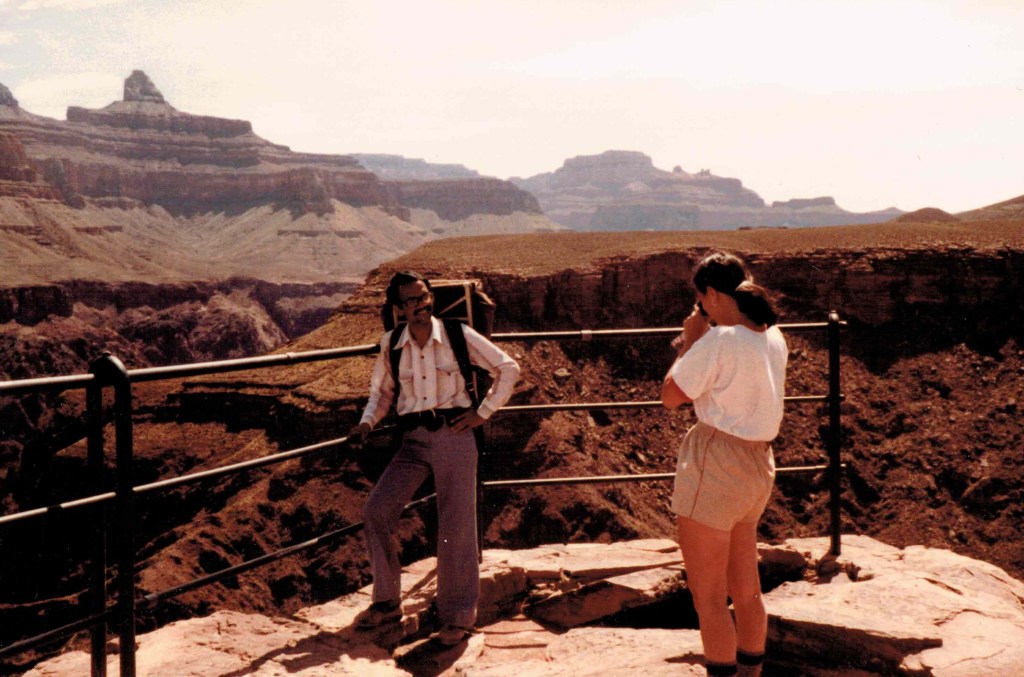
We didn’t go down too far, but waited a long time beside the trail before we got many survey takers. Backpackers that had just started down the trail weren’t surveyed, as they had just started their trip, had not had much time to process the air traffic, and were eager to keep moving. I surveyed a few backpackers coming up from the campground, but it was really a trickle. P.S.’s customers were more cooperative. Aircraft kept his small decibel meter jumping. Was I discouraged? No way! I had the greatest job on the planet!
 Mi Mayan Hamaca