MY UNCLE, AND HERO, LELAND MORRIS HICKMAN, JR.
Leland was the older brother to my mother, Jane Ann Hickman Bobbitt. I enjoyed his visits to our home in Connecticut, and the trips down to New Jersey to visit him, his wife Shanee, and our wonderful cousin, Lisa; the only first cousin I ever had. We had fun together as families, and I greatly enjoyed my uncle’s company.
My uncle was a bright, insightful thinker. Like my father, he had an opinion or an idea about most any subject. He was a voracious reader, and turned me on to my first Ray Bradbury (Martian Chronicles), and Asimov (Robot Trilogy), as well as other literary gems. He loved Peanuts (Charles Schultz), too, and would frequently bring us the latest collection. He was the first person I knew to own a computer (TRS-80), and, generally, one charming personality. I think that comes out clearly in this family photo.
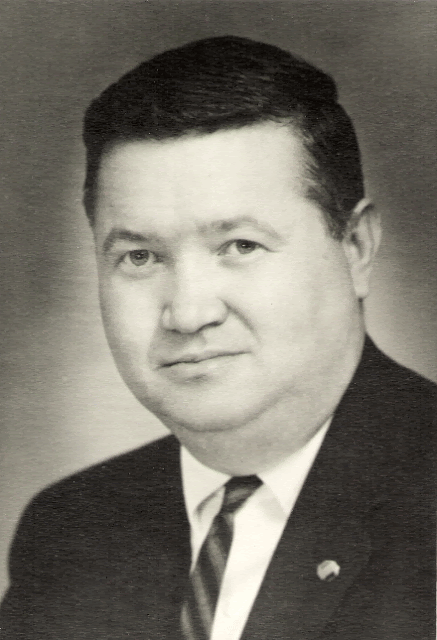
As a child, I knew that he had served in World War II, and that he had been hurt there. People didn’t discuss the situation much in front of kids; one arm did not work well, and was painful.

I recently visited the beautiful World War II monument in Washington, D.C., and looked up my uncle’s record on the computer registry there. He was listed, entered by a friend I had never heard of, Sonny Smith. It indicated that he had fought in Europe, and been wounded.
I spoke with my mother, and shortly thereafter received a package. Carefully folded inside was a collection of newspaper clippings. I could feel the anxiety of my Grandmother (Leland was her beloved son), Grandfather, and Mother as these reports from the front arrived in their West Virginia community. I could feel the tears that must have fallen when news came that their boy was hurt, but blessedly not killed, in action.
My mother provided this information:
“The only other information that I found is a group picture which is marked Company C, 125th Armored Engineers Bn., Camp Campbell, KY – 1944.
“Note that he was in Europe from the end of October, 1944 to the end of March, 1945. He was wounded the 4th of March.
“Leland was at Ohio State in the Army Specialized Training Corps before Camp Campbell. The ASTP was for people who tested exceedingly well. When things got bad, they pulled people out of that program and put them into trained units as replacements. Their training was pretty limited. Through the years, I have met several people who were in ASTP. They were all impressive to me.
“Leland had shrapnel wounds in the back and left arm – several places. He had many operations in both areas. He had some very early nerve transplants to give him partial hand control.
“He had been at West Virginia University when he enlisted. When he returned to his engineering program there, they told him that there was no way he could be an engineer with his arm handicap. He then went to Carnegie Mellon (then Carnegie Tech.) to study industrial engineering. This was engineering with more brain work than hand work.”
Also included in the package was an Honorable Discharge from the Army. It confirmed the unit, and was issued at McGuire General Hospital, Richmond, Virginia on January 28, 1946. It listed him as a Rigger 189, qualified as Marksman Rifle M1 and Carbine. He participated in the campaign of Germany, and the decorations and citations section lists “EAME Theatre Ribbon with one (1) Bronze Star, Purple Heart, American Theatre Ribbon and a Good Conduct Ribbon.”
It indicates he was wounded in action January 14th, 1945 in Germany. He received $178.97 at the time he was discharged, including $20.25 to travel home to West Virginia. The document was recorded at Doddridge County, West Union, West Virginia June 11th, 1946 (Book 2, Page 144).
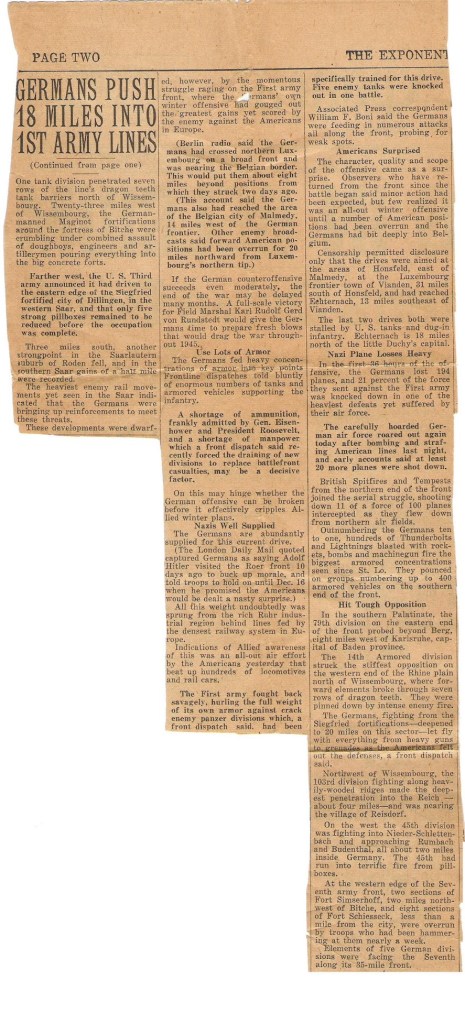
The clippings are tanned and worn. Most appear to be from the Clarksburg, West Virginia Exponent. They deal with the war in general, and do not mention my uncle’s unit specifically. They do, however, tell the tale of a ferocious battle raging as troops reached the German “Motherland.”
Actually, the first clipping precedes American involvement in the war; it is a tract by Rev. William J. Bonner on “What is Salvation?” Both of my Grandparents were quite devout. I’m sure it provided some comfort in their anguish.
Another clipping states:
December 14, 1944: Germans Push 18 Miles into 1st Army Lines – describes fighting near Wissembourg, near what had been rebuilt of the French Maginot line. “The heaviest enemy rail movements yet seen in the Saar indicated that the Germans were bringing up reinforcements to meet these threats.” Berlin Radio said “the Germans had crossed northern Luxembourg on a broad front,” and “enemy broadcasts said forward American positions had been overrun for 20 miles northward from Luxembourg’s northern tip.” The paper goes on to indicate that if the “German counteroffensive succeeds even moderately, the end of the war may be delayed many months . . .” and “. . . drag the war throughout 1945.” The Germans were feeding “heavy concentrations of armor into key points. Frontline dispatches told bluntly of enormous numbers of tanks and armored vehicles supporting the infantry.”
“A shortage of ammunition, frankly admitted by General Eisenhower, and President Roosevelt, and a shortage of manpower, which a front dispatch said recently forced the draining of new divisions to replace battlefront casualties, may be a decisive factor.”
“. . . minor action had been expected, but few realized it was an all-out winter offensive until a number of American positions had been overrun and the Germans had bit deeply into Belgium.”
Another article, undated, goes on to say “The German high command hurled scores of thousands of crack troops and large numbers of tanks into the great fluid battle that may decide the entire course of World War II.”
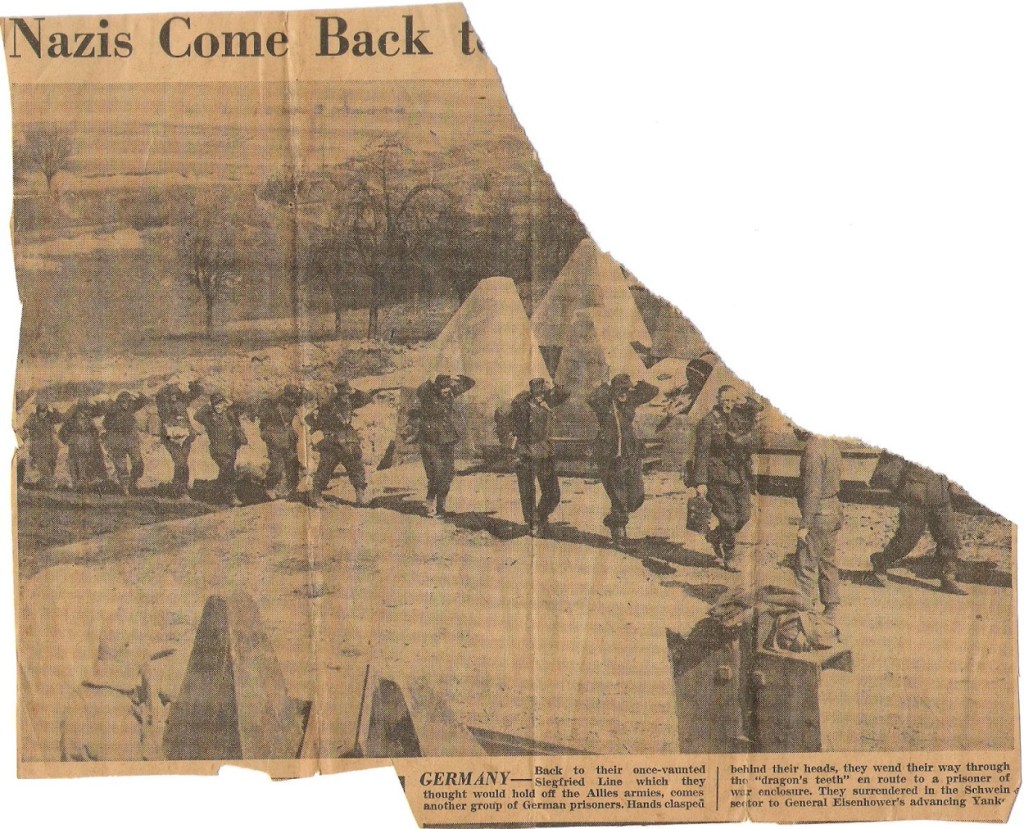
A photo shows ” . . . another group of German prisoners. Hands clasped behind their heads, they wend their way through the “dragon’s teeth” [of the Siegfried Line] en route to a prisoner of war enclosure . . .”
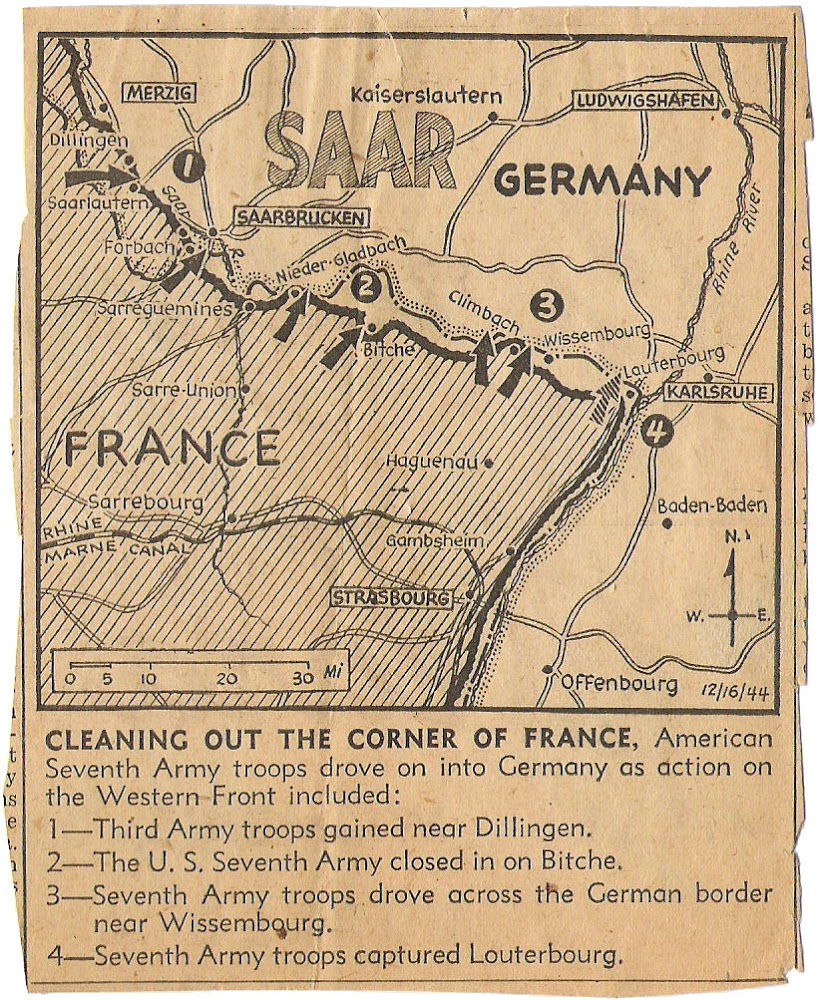
A final map shows the progress of the Third and Seventh Armies as they “clean out the corner of France and head toward the Saarland,” dated December 16, 1944.
Leland eventually went to work at Chase Manhattan Bank in New York City, and lived until 1979. I will always remember his kindness and inquisitive nature. He will always be, along with my Grandfather who rarely spoke of World War I, my war hero!
Link to Leland Hickman’s World War II Registry Record.
Articles from my Grandmother, over which many tears, I am sure, were shed.:
News articles referenced are from the Clarksburg, West Virginia Exponent.
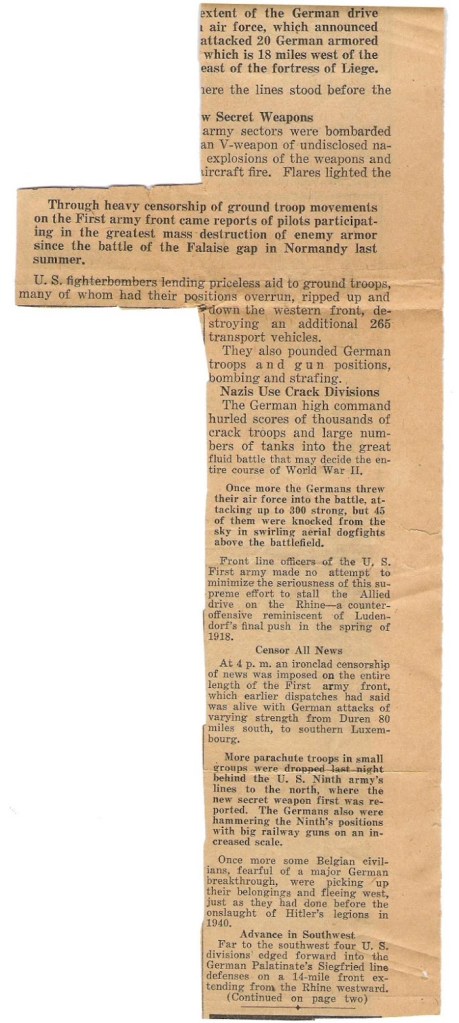
Religious Sermon Article: Also from the Clarksburg, West Virginia Exponent, December 9, 1939.

A plea for prayer and salvation wrapped around the bitterness and tragedy of war, right from the middle of the most desperate of it all. It nearly broke my heart the first time I read through all of this tragedy. How it must have created such anxiety within my grandmother, living through a tragic experience through news clips; having a son on the front lines.
It is quite a time capsule. I’m so glad my mother shared. I am glad I can, too.
Here is a family album.
 Mi Mayan Hamaca